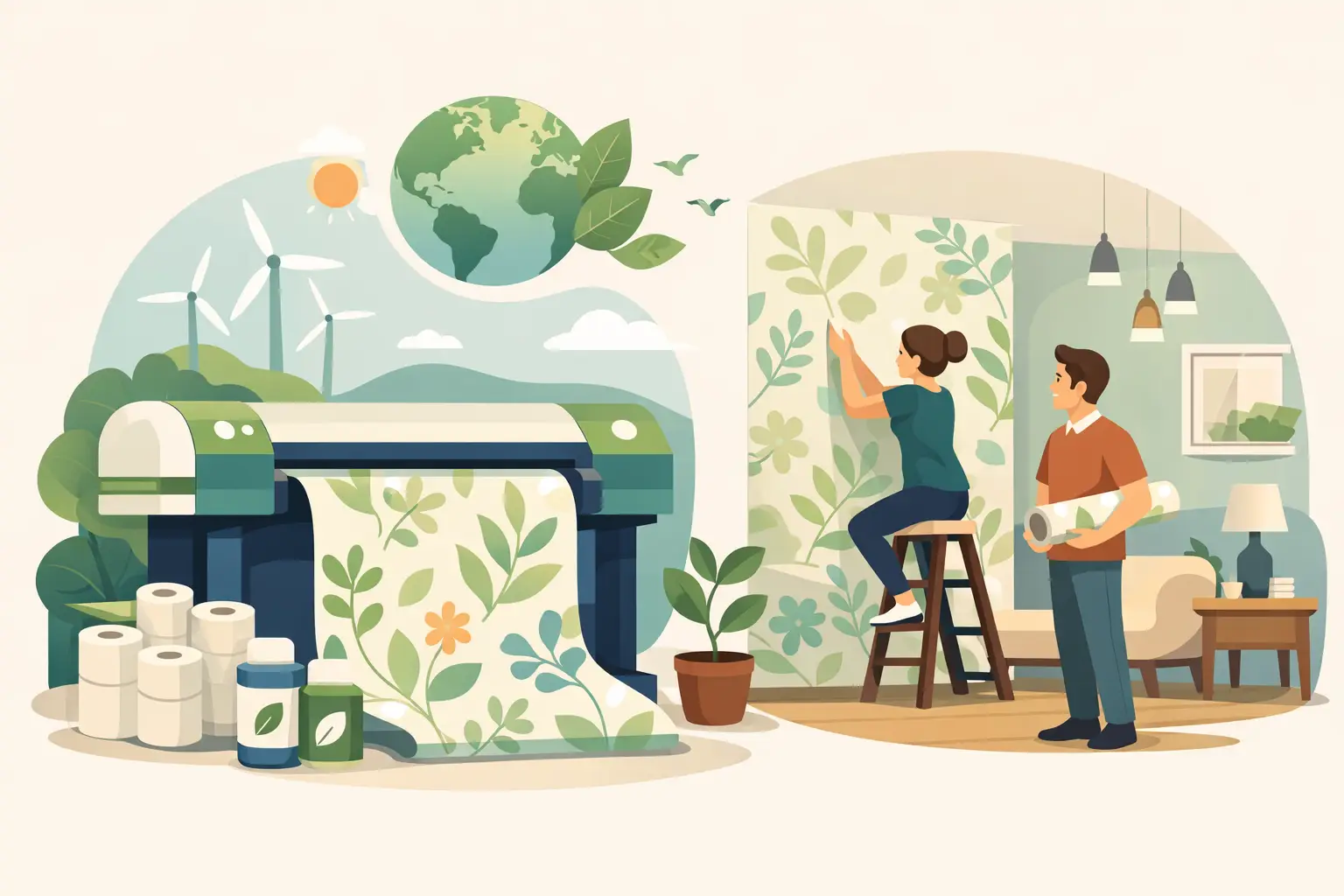
A statement wall should elevate a room without creating an environmental compromise hidden behind the pattern. Eco friendly wallpaper printing brings together expressive color, custom-scale design, and more considered production choices for homes, workplaces, hospitality spaces, and retail environments. The result is not simply a greener-looking finish. It is a wallcovering specified for visual impact, everyday performance, and a more responsible material story.
For designers and project teams, the best choice is rarely defined by one claim on a sample book. Ink chemistry, substrate, adhesives, longevity, print accuracy, and installation standards all affect the final environmental footprint. A well-specified wallcovering also needs to look exceptional after years of real use.
Eco friendly wallpaper printing is a design and production approach that aims to reduce impact across the wallcovering’s life cycle. This may include low-odor or water-based ink systems, responsibly sourced paper or nonwoven substrates, efficient digital production, and materials selected for durability rather than short-term replacement.
The phrase should not be treated as a blanket promise. One wallpaper may use lower-emission inks but have a less favorable backing. Another may use a recycled-content substrate yet be unsuitable for high-traffic areas, leading to earlier replacement. The stronger specification considers the complete project: where the wallcovering will be installed, how it will be maintained, how long it is expected to perform, and what documentation supports its environmental and indoor-air-quality claims.
Digital printing is particularly valuable for custom work because it produces to order. Instead of committing to large print runs and excess inventory, a mural or bespoke wallcovering can be produced to the required dimensions. This supports creative freedom while helping reduce unnecessary material waste.
Ink is central to both color performance and the indoor experience of a finished space. For residential interiors, hotels, offices, clinics, and retail settings, lower-odor printing can be especially desirable when spaces need to be occupied soon after installation.
Modern digital systems, including advanced Canon printing technology, can deliver precise detail, rich tonal variation, and high-resolution imagery without relying on the heavy solvent odor associated with older printing methods. Depending on the application, water-based, latex, or other lower-impact ink options may be appropriate. The best choice depends on the substrate and the performance requirements of the project.
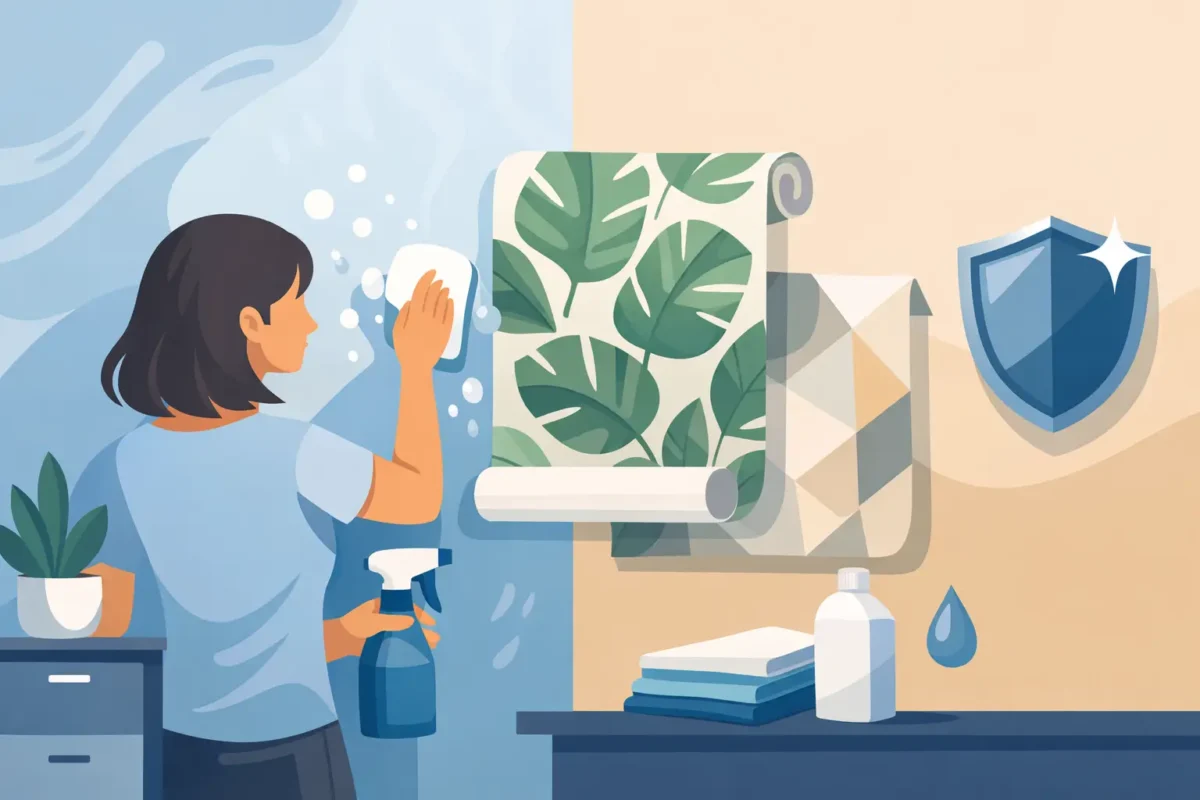
Do not assess ink only by its environmental language. Ask whether the printed finish is suitable for the room’s lighting, cleaning routine, and expected wear. A delicate finish may be right for a private bedroom, while a lobby, corridor, restaurant, or retail environment may call for a more durable commercial-grade surface. A wallcovering that withstands cleaning and daily contact can be the more responsible choice over its service life.
A common concern is that environmentally considered printing may limit color saturation or creative range. With the right print technology and material pairing, that is no longer the case. Fine botanical linework, dramatic stone textures, atmospheric landscapes, branded graphics, and layered abstract compositions can all retain their depth and clarity.
Color management matters here. A custom mural should be reviewed for scale, repeat alignment, image resolution, and the way its colors respond to the selected substrate. Matte, textile-inspired, smooth, and lightly textured grounds each interpret ink differently. Professional sampling helps ensure that the chosen design delivers the intended finish before full production begins.
The base material carries much of the wallcovering’s performance. Paper, nonwoven, vinyl, textile-backed, and fabric-backed options each serve different priorities. There is no single material that is automatically best for every interior.
For feature walls in low-traffic residential spaces, a paper or nonwoven wallpaper can offer a refined finish with a lighter material profile. Nonwoven materials are often valued for dimensional stability and easier handling during installation. For commercial settings, fabric-backed wallcoverings may be more suitable because they are engineered for durability, maintenance, and demanding daily use.
When reviewing eco-friendly options, look beyond a generic label. Consider whether the substrate includes recycled or renewable content, whether the sourcing is documented, and whether the product has relevant low-emission certifications for the market. These details are especially relevant for architects, developers, and hospitality operators working within project specifications or green-building requirements.
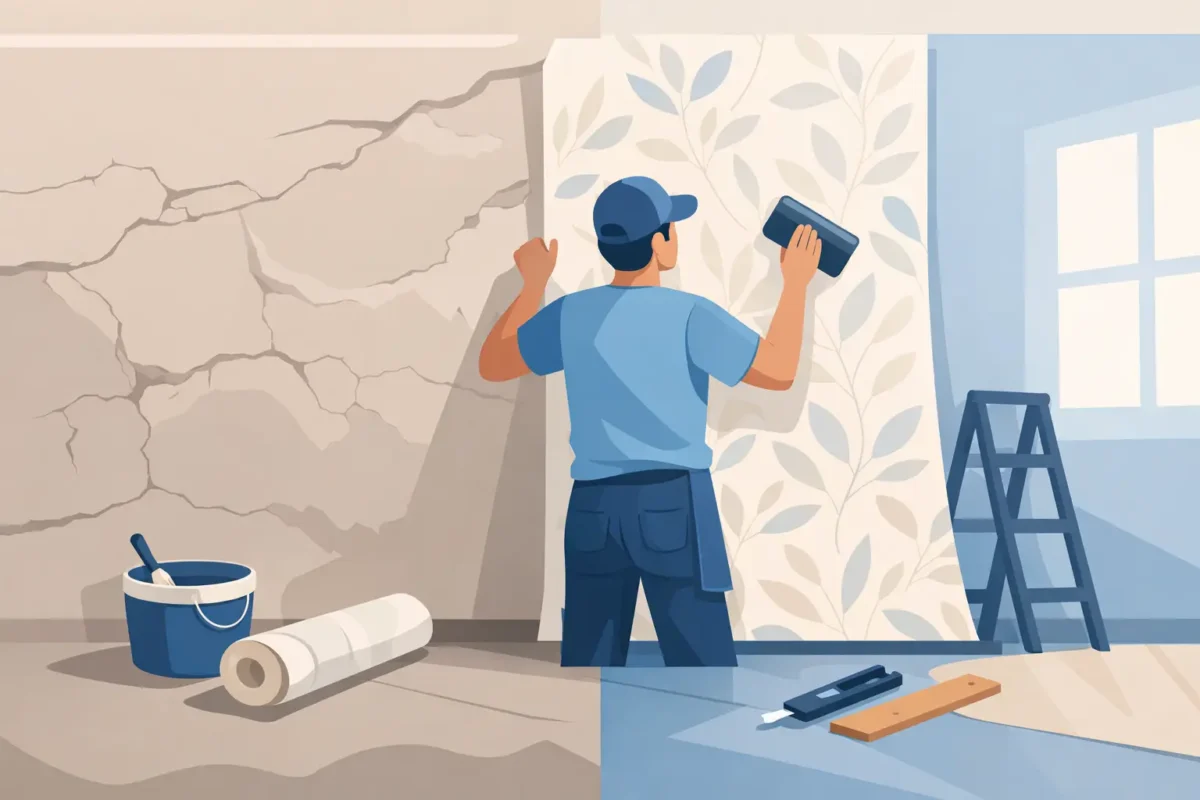
Material selection must also account for wall condition. A highly textured or uneven wall may require preparation or a more forgiving wallcovering construction. Choosing a material that performs properly on the existing surface avoids failed installation, wasted product, and avoidable rework.
The most sustainable wallcovering is not always the thinnest or simplest material. In a busy commercial interior, a finish that tears, stains, or scuffs easily can become waste faster than expected. Durability is therefore a practical part of responsible specification.
For offices, hotels, healthcare-adjacent spaces, retail stores, and public-facing corridors, consider cleanability, abrasion resistance, fire performance, and resistance to moisture where appropriate. These requirements should be confirmed against the exact product, not assumed from its appearance. A wallcovering can be beautiful and still be engineered for demanding environments.
Longevity also comes from timeless design decisions. A custom mural does not need to be visually quiet, but it should feel intentional enough to remain relevant after a seasonal trend passes. Rich neutrals, natural textures, place-based artwork, and brand-aligned graphics often provide more lasting value than an overly temporary motif.
Custom printing gives projects a valuable advantage: the design can be tailored to the wall rather than forced to fit a standard roll. Accurate site measurement is essential. It allows the artwork to account for ceiling heights, doors, windows, columns, switches, and furniture placement before production begins.
This is especially important for murals. A horizon line that disappears behind a headboard, a logo interrupted by a doorway, or a focal element cut at the ceiling can diminish an otherwise strong concept. Thoughtful artwork placement improves the finished result and reduces the risk of reprinting.
For larger projects, it is worth coordinating design approval, wall preparation, production, and installation as one process. Decorating Depot approaches wall décor as a complete project solution, combining design variety, custom print capability, material guidance, and professional installation support. That coordination is not only convenient. It helps protect the material investment and ensures the selected wallcovering performs as intended.
Even a carefully selected printed wallpaper can be undermined by poor installation. Incorrect adhesive, insufficient wall preparation, rushed seam work, or moisture trapped beneath the surface can shorten the lifespan of the finish.
Ask installers to assess the wall substrate, moisture conditions, and required preparation before work begins. The adhesive should be compatible with both the wallcovering and the wall surface. Low-VOC adhesive options may be worth considering where indoor-air-quality priorities are high, though compatibility and long-term bond strength must remain the deciding factors.
Professional installation also supports a cleaner finish. Properly aligned panels, neat trims, and carefully managed seams allow a custom design to read as one continuous composition. This is critical for hospitality and commercial projects, where details shape the perception of quality.
Before approving an eco-conscious wallcovering, request clear answers about the ink system, substrate composition, cleaning guidance, fire rating where needed, and available environmental or indoor-air-quality documentation. For custom prints, confirm the artwork proof, final dimensions, panel layout, and color expectations.
It is also useful to ask how much extra material is recommended for the installation. Some allowance may be necessary for pattern matching, trimming, or future repairs, but unnecessary over-ordering adds cost and waste. An experienced supplier can advise on the right balance for the design and site conditions.
Eco friendly wallpaper printing gives designers and property owners a more thoughtful way to create distinctive interiors. It supports made-to-measure murals, elevated decorative finishes, and commercial-ready performance without treating sustainability as an afterthought.
The strongest result comes from choosing a wallcovering for its full value: the quality of its print, the suitability of its material, the durability of its surface, and the care taken in installation. When those choices work together, a statement wall can remain beautiful, functional, and relevant long after the project is complete.