A statement wall is only as successful as the material behind it. A beautiful pattern can lose its impact when it is installed in the wrong setting, whether that means moisture in a powder room, scuffs in a busy corridor, or visible seams across a feature wall. This wallpaper material comparison looks beyond surface appearance to help you choose a finish that performs as beautifully as it looks.
For homeowners, the right choice may be driven by maintenance and visual warmth. For designers, developers, hospitality teams, and business owners, it may also involve fire performance, traffic levels, installation requirements, and long-term replacement planning. Material is not a technical afterthought. It is part of the design specification.
Wallpaper materials vary in their backing, face finish, thickness, breathability, texture, and resistance to wear. Those differences affect how a wallcovering hangs, how it responds to humidity, how easily it can be cleaned, and how convincing its final finish appears under daylight or architectural lighting.
There is no single best material for every project. A delicate paper wallcovering can bring extraordinary character to a private bedroom, while a vinyl surface may be the more sensible choice for a restaurant entry or family hallway. The strongest selection begins with the room’s demands, then matches performance with the intended design effect.
Vinyl wallpaper is among the most versatile options for residential and commercial interiors. It has a decorative surface protected by a vinyl layer, making it more resistant to everyday moisture, marks, and cleaning than standard paper-based alternatives. Many vinyl products are suitable for kitchens, hallways, children’s rooms, offices, retail interiors, and other spaces where walls receive regular contact.
The finish can range from smooth and contemporary to embossed, textile-inspired, stone-like, or richly patterned. This makes vinyl a strong option when you want a high-impact visual without treating the wall as fragile. It is especially valuable in spaces where paint would require frequent touch-ups.
Not all vinyl wallpaper is identical. Lightweight residential vinyl may suit moderate-use rooms, while heavier commercial-grade constructions are designed for more demanding environments. Before specifying it for a large project, consider cleaning protocols, traffic levels, wall condition, and any required fire-retardant documentation.
Non-woven wallpaper is made from a blend of synthetic and natural fibers. It is valued for its dimensional stability, breathability, and installer-friendly application. In many cases, adhesive is applied directly to the wall rather than the back of each strip, helping reduce expansion and making positioning more controlled.
This material is a polished choice for bedrooms, living rooms, dining areas, private offices, and boutique commercial settings. It supports detailed printing and can create a crisp, elevated finish, from soft botanicals to architectural geometrics and large-scale mural designs.
Non-woven wallpaper is often easier to remove than traditional paper wallpaper when the time comes to refresh an interior. That advantage matters in properties where design updates are planned every few years. Its durability is good, but it is generally not the first choice for areas exposed to constant impact, heavy grease, or frequent wet cleaning.
Traditional paper wallpaper offers a distinctive tactile quality that is difficult to imitate. It can feel artisanal, layered, and visually nuanced, particularly in heritage-inspired prints, hand-finished effects, and delicate decorative patterns. For a formal bedroom, lounge, library, or carefully styled guest room, paper can deliver an unmistakably sophisticated result.
Its trade-off is maintenance. Paper is less forgiving around humidity, splashes, and abrasion. It also needs careful preparation and professional installation, as pasted paper can expand before drying and may show imperfections if the wall is not properly finished. In a controlled, low-traffic setting, these considerations are entirely manageable. In a busy commercial restroom or family mudroom, they make paper a less practical specification.
Choose paper for atmosphere, depth, and design authenticity rather than hard-wearing utility. It rewards the right placement.
Fabric-backed vinyl wallcovering is engineered for durability. It combines a vinyl decorative face with a woven or non-woven fabric backing, producing a thicker, more resilient material suitable for high-traffic interiors. Hotels, offices, healthcare-adjacent spaces, retail environments, restaurants, and multi-unit developments often benefit from this level of performance.
Its construction helps it stand up to scuffs, regular maintenance, and the wear associated with public-facing spaces. Many project-grade options are also available with fire-retardant properties and can be specified to meet relevant project requirements. The surface may replicate linen, grasscloth, plaster, wood, leather, or abstract texture while delivering a more practical maintenance profile than the natural material it references.
This is not simply a tougher wallpaper. It is a specification tool for interiors that need visual consistency over time. Because it is heavier and more technical to install, experienced preparation and installation are essential for clean seams, accurate pattern alignment, and a premium final result.
Textile wallcoverings, grasscloth-inspired designs, and other natural-fiber finishes introduce warmth that printed surfaces can rarely match. Their irregularity is often part of the appeal. Slight variations in weave, tone, and panel appearance give a wall a crafted, layered presence.
These materials are particularly effective in executive spaces, luxury residences, hospitality suites, and feature walls where the goal is quiet richness rather than graphic drama. They should be selected with realistic expectations: natural materials may be more sensitive to stains, sunlight, and moisture, and visible panel variations should not be treated as defects.
A practical alternative is a commercial vinyl with a convincing textile or grasscloth texture. It can retain the visual character of a natural finish while offering easier cleaning and stronger performance. The decision comes down to whether authentic material variation or routine durability is the higher priority.
Custom print wallpaper is defined less by one material and more by what it makes possible. A brand story, original artwork, cityscape, illustrated landscape, or project-specific color palette can be printed to fit the exact dimensions of a wall. This is particularly valuable for feature walls, hospitality concepts, retail campaigns, corporate interiors, and homes that call for a personal point of view.
The substrate still matters. A custom mural for a reception area may need a durable, washable finish, while a bedroom mural may prioritize soft visual texture and low sheen. Print technology, ink quality, color control, and panel planning all influence the result. A high-resolution image alone is not enough if the material is poorly suited to the wall or the environment.
Decorating Depot combines advanced Canon printing technology with material guidance and professional installation support, helping custom concepts move from a digital file to a finished surface with greater confidence. For large murals, precise measurement is especially important. Doors, windows, switches, coves, and furniture lines should be considered before production, not after installation begins.
A small sample can make almost any finish look right. The better question is how the wallpaper will live in the space. In a humid bathroom, use a product approved for moisture-prone conditions rather than assuming all vinyl is suitable. In a sunlit living room, ask about colorfastness and consider how strong afternoon light will affect the finish. In a hotel corridor or office lobby, prioritize commercial-grade durability and maintenance requirements.
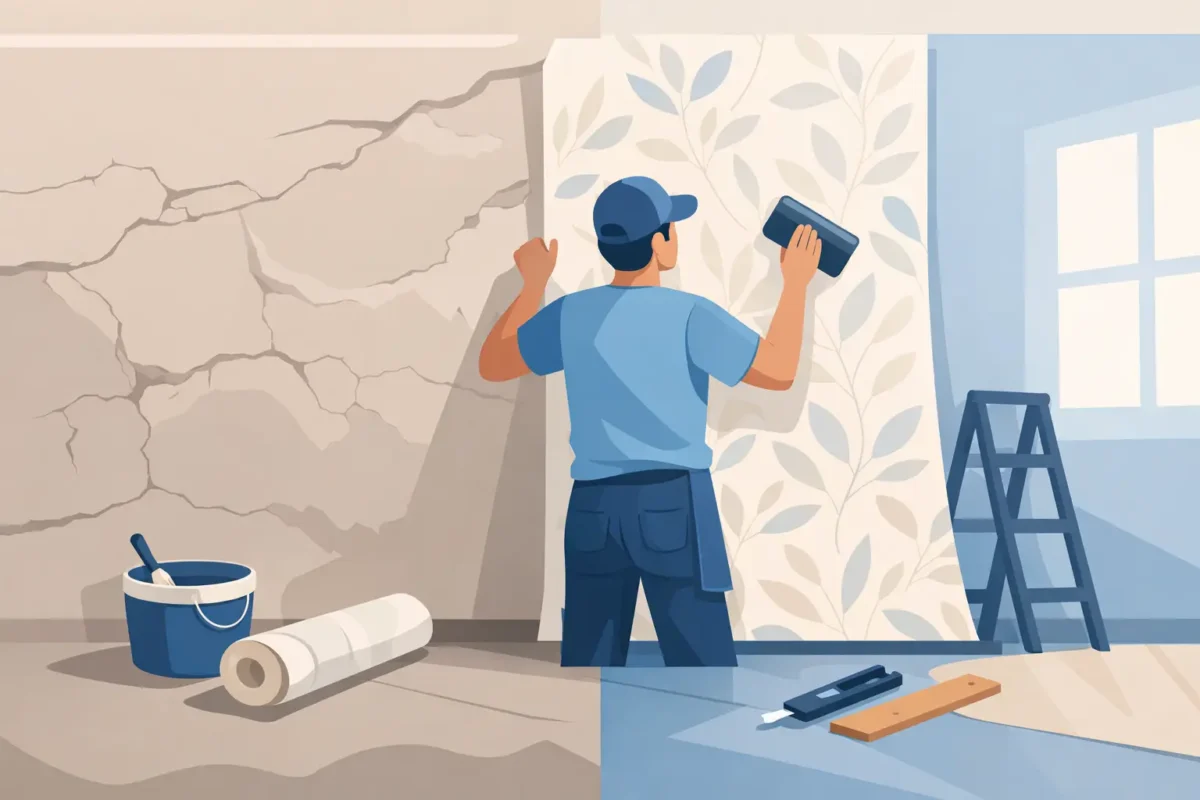
Wall condition deserves equal attention. Dark colors, glossy surfaces, and fine geometric patterns can reveal uneven substrates more readily than textured or mid-tone designs. Older walls may need repair, smoothing, priming, or lining before wallpaper installation. Cutting corners at this stage can compromise even the most premium wallcovering.
Scale also changes the decision. A bold paper in a small powder room may be an inspired choice because it receives limited wear. The same material across a large family room or public lounge may create unnecessary maintenance risk. Material selection becomes more accurate when it is considered room by room.
Sheen and texture are often overlooked in a wallpaper material comparison, yet they shape both appearance and upkeep. Matte finishes feel softer and more architectural, but they can be less forgiving of fingerprints than a lightly textured or washable surface. Metallic details can add drama under controlled lighting, while heavily reflective finishes may emphasize wall imperfections.
Texture can also alter acoustics and perceived warmth. A linen-like wallcovering may make a boardroom feel more considered, while a smooth custom mural can create an expansive, gallery-style focal point. Choose the finish with the full room in mind: lighting, furnishings, cleaning needs, and the distance from which people will experience the wall.
The most memorable walls do more than carry a pattern. They support the way a space is used, maintained, and remembered. Specify the material with the same care you give the design, and the finished wall will continue to make its statement long after the first impression.