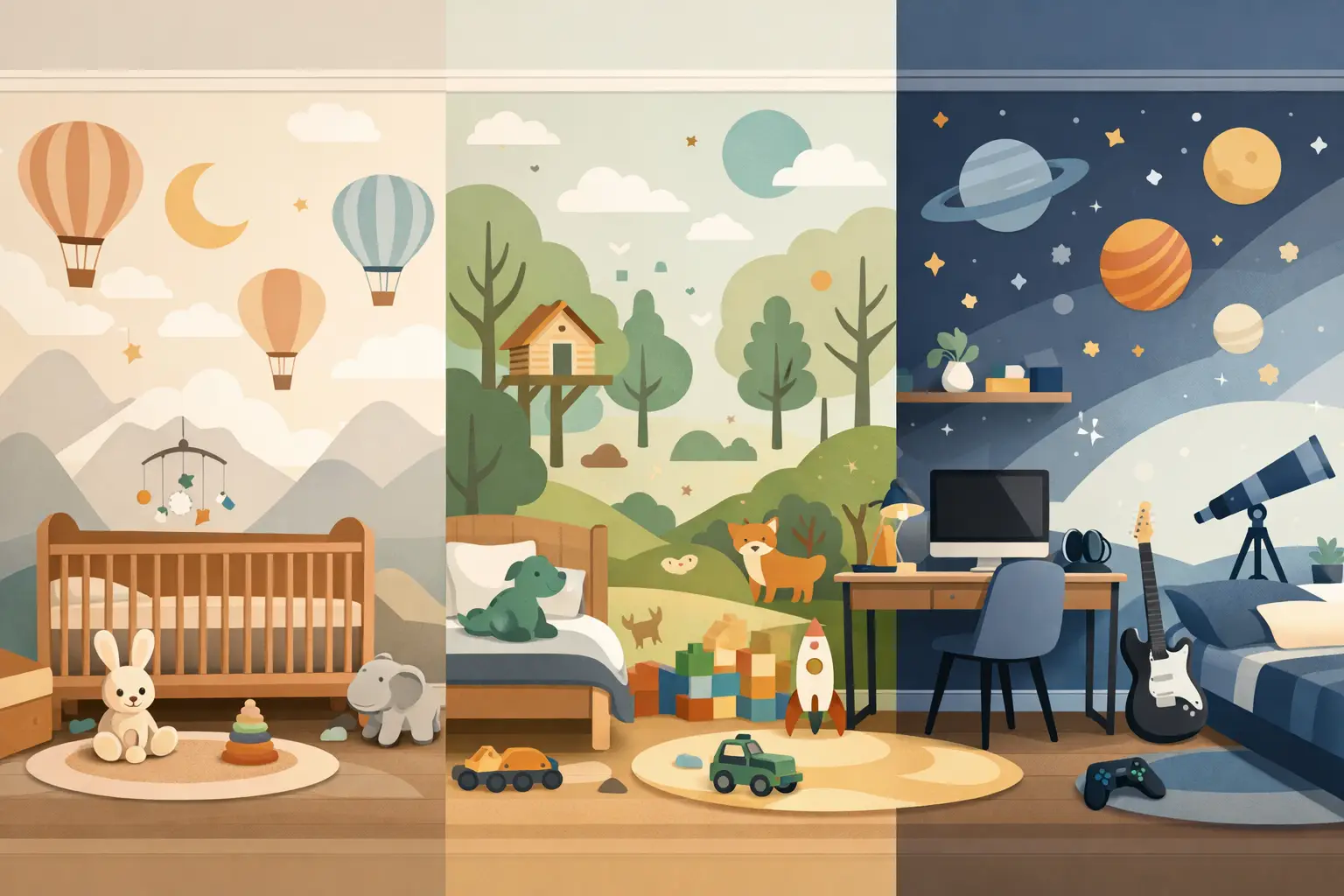
A child’s room changes quickly. One year, it is a cozy nursery with soft animals and cloud motifs; a few years later, it needs to hold books, hobbies, sleepovers, and a growing sense of independence. The right kids wallpaper gives the room a strong point of view without making it feel temporary. It can create comfort at bedtime, encourage imaginative play, and bring a professionally finished look to a space that works hard every day.
For homeowners, designers, and developers, the question is not simply which print looks charming. It is how to select a wallcovering that suits the child now, performs under real family life, and continues to feel considered as the room evolves.
A bedroom, playroom, nursery, and shared sibling space ask different things from their walls. A nursery often benefits from a calmer visual rhythm: delicate botanicals, soft stripes, hand-drawn animals, or muted celestial scenes can make the room feel restful without becoming bland. In contrast, a playroom can carry more energy. Colorful maps, illustrated cityscapes, jungle patterns, and imaginative murals give children a backdrop for activity while helping define the room’s personality.
For a bedroom used by an older child, consider what must coexist in the space. Sleeping, studying, dressing, and relaxing may all happen within one room. Wallpaper can separate those functions visually. A mural behind the bed can create a focal point, while a more understated texture near a desk keeps the work area calm and usable.
Shared rooms need a little more restraint. Choosing a design with broad appeal, such as stars, abstract shapes, soft checks, or nature-inspired scenery, prevents the room from belonging too strongly to one child. Color is often the easiest way to personalize later through bedding, lamps, artwork, and storage.
The most successful kids wallpaper does not always feature a favorite character or a very specific theme. Those designs can be joyful, especially in a play area or a temporary space, but they may have a shorter design lifespan. If the goal is a room that can mature gracefully, select a pattern that reflects an interest without illustrating it too literally.
A child who loves space may outgrow cartoon rockets but still enjoy a sophisticated night sky, a moon-phase pattern, or a deep blue mural with subtle constellations. A young animal lover may respond just as well to an elegant woodland scene or a botanical print as they would to a novelty animal pattern. The design feels personal, yet it will not need replacing as soon as their preferences shift.
Scale matters as much as subject. Large-format murals make a powerful statement and can visually expand a smaller bedroom, particularly when they feature landscape depth, sky, or an open horizon. However, a busy large-scale print across every wall can feel overwhelming in a compact room. In that setting, one feature wall paired with coordinating painted walls usually creates a more balanced result.
Small repeating patterns have a different strength. They bring texture and warmth without competing with furniture, wall art, or colorful toys. Stripes, dots, gentle geometrics, and small florals are particularly adaptable choices for rooms expected to change over time.
Color should respond to both the room’s light and its purpose. Soft blue, sage, warm beige, dusty pink, and muted lavender can support a quiet bedroom atmosphere. Richer greens, ochres, coral tones, and confident blues bring energy when used in moderation. A vivid design may look beautiful on a sample, but it deserves to be viewed in the actual room at different times of day.
Natural light can make a pale wallpaper feel brighter and cooler, while warm artificial lighting may deepen beige, blush, and cream tones. North-facing rooms often benefit from warmer palettes. Bright, sun-filled rooms can handle cooler colors or darker feature walls with greater ease.
For a polished finish, pull two or three colors from the wallpaper into the rest of the room. This could mean a painted ceiling detail, a reading chair, bed linens, or drawer fronts. The space will feel coordinated without looking overly matched.
Children’s spaces are not low-contact interiors. Walls may face fingerprints, scuffs, toy impacts, adhesive tape, and the occasional creative experiment. That makes material selection a design decision as well as a maintenance decision.
Washable wallcoverings are a practical choice for bedrooms and playrooms because minor marks can be addressed more easily than on standard painted drywall. Vinyl and vinyl-coated options can offer added durability where activity levels are high, while premium non-woven wallcoverings are valued for their dimensional stability and refined finish. The best choice depends on the location, expected wear, wall condition, and the desired visual effect.
For high-traffic family zones, built-in play areas, childcare settings, or hospitality projects designed for children, project-grade wallcovering deserves serious consideration. Fabric-backed commercial wallpaper is engineered for demanding environments and can offer excellent durability, maintenance performance, and specification options. Where project requirements call for fire-rated materials, confirm the relevant rating, documentation, and local code requirements before final selection.
Custom print wallpaper adds another dimension. A favorite illustration, a branded children’s zone, an educational graphic, or a tailored mural can be scaled to the wall rather than forced into standard repeat dimensions. High-quality printing and eco-conscious ink choices help support a precise, polished result, particularly for spaces where color accuracy and detail matter.
A feature wall should have a reason. Behind the bed is an obvious choice because it frames the room’s central piece of furniture and remains visible even when the floor is busy with toys. The wall facing the doorway is another strong option, especially for a mural designed to make an immediate impression.
Avoid placing a detailed mural on a wall that will be largely hidden by tall wardrobes, heavy shelving, or blackout drapes. If storage must sit against the wall, a repeating pattern can be more forgiving than a scene-based mural. Also consider doors, windows, air-conditioning units, outlets, and switches. These elements affect both the composition and the amount of material required.
Professional measurement is worth the effort for custom work and premium wallcoverings. A room may appear square while its corners, ceiling lines, or wall surfaces tell a different story during installation. Accurate assessment helps ensure the pattern alignment, mural crop, and material quantities are right from the start.
Even an exceptional design can lose impact through visible seams, poor alignment, bubbling, or weak edge adhesion. Proper wall preparation is essential. Surfaces should be clean, dry, smooth, and suitably primed before installation. Existing paint condition, moisture exposure, hairline cracks, and wall texture all need to be evaluated.
Professional installation is especially valuable for murals, large repeats, textured materials, and commercial-grade products. Installers understand how to position the first panel, manage pattern matching, work around architectural details, and achieve clean finishing at corners and edges. The result is not merely neater. It protects the investment in the material itself.
A well-chosen wallcovering can remain in place while the room changes around it. Instead of replacing the walls at every new stage, update the elements that are easier to switch: bedding, posters, rugs, lamps, desk accessories, and display shelves. A neutral woodland mural can move from crib years to a first bed. A graphic stripe can work for a preschooler, a school-age child, and a teenager with entirely different furnishings.
This approach is particularly valuable for developers and hospitality operators. Family-friendly rooms should feel memorable, but their finishes also need to withstand turnover and remain broadly appealing. Thoughtful kids wallpaper balances imagination with longevity, giving the interior a distinctive identity without narrowing its future use.
At Decorating Depot, the strongest children’s spaces begin with that balance: expressive design, the right material for the setting, accurate customization, and installation finished to a professional standard. Choose a wallcovering that gives children a world of their own, while giving the room every reason to stay beautiful as they grow.